







Hair Loss After Childbirth: Causes and Natural Remedies
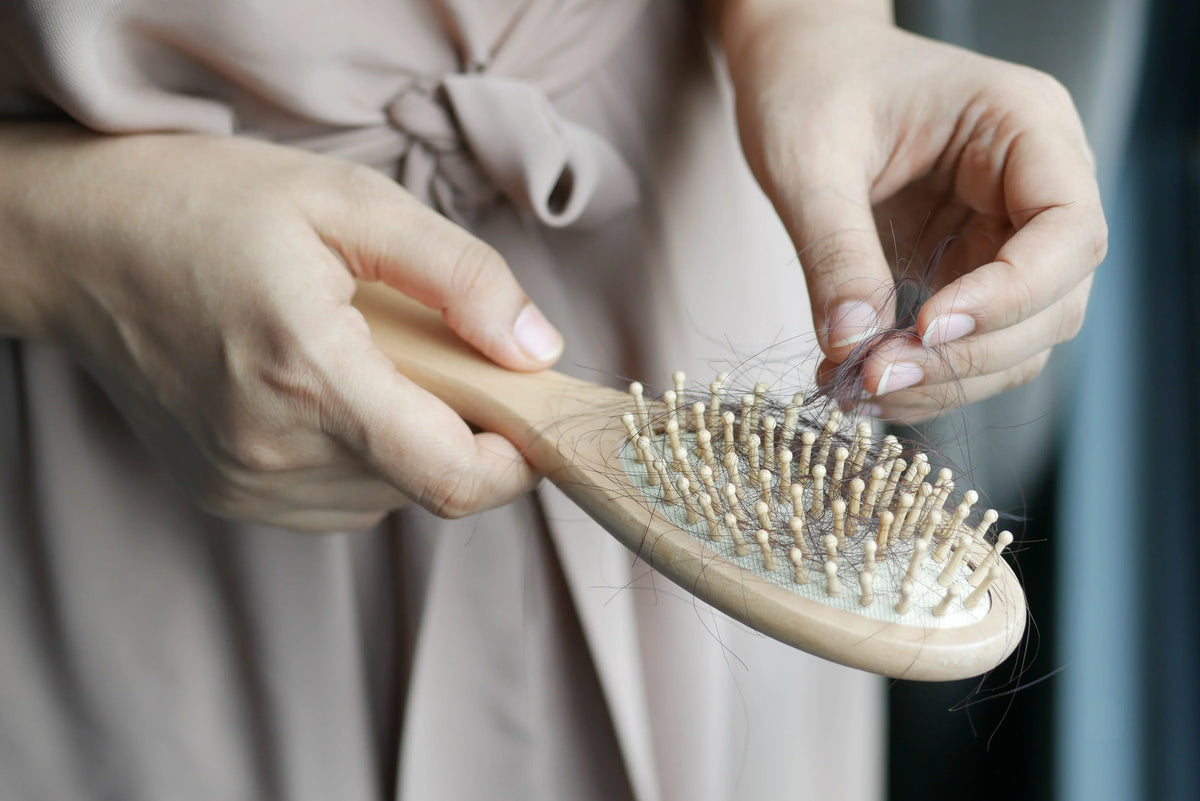
The shower is full of hair. The pillow, the brush, the bathroom floor. You're not crazy: hair loss after childbirth is a physiological condition affecting up to 60% of women, typically between the 2nd and 6th month after delivery. It's called postpartum telogen effluvium (PPTE) and in most cases resolves spontaneously in 6-12 months. But this doesn't remove the anxiety of seeing strands fall every day.
In this guide we explain what happens to hair during pregnancy and after childbirth, when the loss is normal and when medical evaluation is instead needed (thyroid, ferritin, vitamin D). We see natural remedies safe during breastfeeding — because not everything "natural" is compatible with breastfeeding — and how targeted supplements like Galega + Saffron + micronutrients can support hair, mood and lactation in the same protocol.
What is postpartum telogen effluvium
Hair has a natural cycle with three phases: anagen (growth, 2-6 years), catagen (transition, 2 weeks), telogen (rest and fall, 2-4 months). In a healthy woman, about 85-90% of hair is in anagen and 10-15% in telogen: 50-100 hairs falling per day is physiological.
During pregnancy, high oestrogen levels keep many hairs in prolonged anagen phase: result, thicker and shinier hair. At delivery, oestrogens crash rapidly and most of these hairs enter telogen phase together: 2-4 months later they start falling en masse.
When it starts and how long the postpartum fall lasts
- Typical timing: fall begins between 2 and 6 months after delivery (peak around 3rd month)
- Average duration: 3-6 months of accentuated fall
- Complete recovery: 9-12 months after delivery
In most cases PPTE leaves no aftermath: hair density returns to pre-pregnancy within 12 months. In a minority a more marked thinning persists especially at temples and parting.
Causes of postpartum hair loss
Oestrogen crash
Main cause. Pregnancy oestrogen peak keeps hair in anagen; after delivery, rapid return to baseline causes synchronisation of many follicles in telogen phase.
Nutritional deficits
Pregnancy and breastfeeding are metabolically demanding. Most impactful deficits on hair:
- Iron / ferritin: deficit common postpartum. Ferritin < 30 ng/mL is associated with accentuated fall
- Vitamin D: foetus and newborn "drain" maternal reserves. Deficit < 30 ng/mL common
- Zinc: cofactor of hair protein synthesis
- Vitamin B12 and folates: especially in vegetarian/vegan women
- Biotin: real deficiencies rare, but can support fibre quality
- Proteins: insufficient intake reduces keratin production
Stress and sleep deprivation
Postpartum is by definition a period of physical and psychological stress and fragmented sleep. Elevated cortisol pushes additional follicles into telogen.
Postpartum thyroiditis
Up to 10% of women develop postpartum thyroiditis (hyperthyroid phase followed by hypothyroid phase, 3-12 months after). Both phases cause hair loss. Diagnosis not to miss: dose TSH, FT4, anti-TPO antibodies between 3rd and 6th month postpartum.

Normal vs alarm symptoms: when to see the doctor
Normal (physiological PPTE):
- Diffuse fall 2-6 months postpartum
- Loss 200-400 hairs/day for 2-4 months
- Reduced density but without bald areas
- Visible regrowth at temples and parting within 6-9 months
To evaluate with doctor:
- Fall persisting more than 12 months after delivery
- Visible thin or bald areas
- Associated systemic symptoms (extreme fatigue, palpitations, sweating, oligomenorrhoea, unstable mood)
- Itching, dandruff, skin redness, scars
Basic tests recommended around 6th month postpartum: blood count, ferritin, TSH+FT4+anti-TPO, vitamin D, vitamin B12.
Realistic expectations and timeframes
An important aspect in managing postpartum hair loss is realistic expectation management. No supplement or cosmetic product drastically accelerates regrowth: times are dictated by the hair cycle. A follicle that has entered telogen can only produce new hair after transitioning to the next anagen phase, which takes 2-4 months. And even the new hair grows at a physiological speed of about 1 cm/month. From falling to visible length, 6-9 months can therefore pass. Knowing these times helps avoid unrealistic advertising promises and reduces frustration.
Natural remedies safe during breastfeeding
Attention: breastfeeding requires prudence in everything taken. Many "hair supplements" contain principles untested or contraindicated in breastfeeding. Safe and useful options:
Postpartum dietary foundations
The foundation for hair regeneration after childbirth is a balanced and calorically adequate diet: in a breastfeeding mother, additional energy needs are about 500 kcal/day above pre-pregnancy needs. Restrictive diets for rapid weight loss are contraindicated: they intensify the fall and compromise lactation.
Diet
- Proteins: 1.5-1.8 g/kg/day (fish, eggs, legumes, dairy)
- Heme iron: red meat 2-3 times/week; non-heme iron with vitamin C
- Omega-3: fatty fish 2-3 times/week or algae DHA 200-300 mg/day
- Nuts: almonds, walnuts for zinc and magnesium
Key micronutrients (safe in breastfeeding)
- Vitamin D 1,000-2,000 IU/day
- Iron: only if ferritin < 30 ng/mL
- Zinc 10-15 mg/day
- Vitamin B12 if vegetarian: 250-500 mcg/day
- Biotin 300-1,000 mcg
Horsetail and organic silicon
The horsetail (Equisetum arvense) is rich in silicon. In breastfeeding safety evidence is limited: prefer formulations with organic silicon in low doses.
Stress and sleep management
Not "treatment" but fundamental: any support for stress management (family network, mom groups, therapy) also reduces impact on hair.
What to avoid in breastfeeding
- Untested multi-ingredient supplements
- High doses of vitamin A retinol (>3,000 IU/day)
- Aggressive cosmetic treatments: frequent ammonia colouring, perms
- Restrictive diets: fast postpartum weight loss worsens fall
Postpartum Supplement Galega + Saffron: how it works
The Postpartum Supplement Breastfeeding Galega + Saffron is the RedMoringa formula specifically designed for the postpartum phase in breastfeeding, combining 3 objectives in a single daily intake:
- Galega officinalis: traditional galactogenic plant, supports milk production
- Saffron: studies show positive effects on mood tone
- Moringa oleifera: micronutritional base — provides iron, calcium, B-vitamins, antioxidants
The iron, zinc and B-vitamins of moringa also support hair fibre, while galega and saffron cover lactation and mood. Cycles of 2-3 months during the acute fall phase.
Postpartum hair cosmetic routine
- Gentle shampoo, without aggressive sulphates
- Nourishing conditioner/mask 1-2 times/week
- Natural bristle brush
- Drying at low temperature
- Avoid tight ponytails, braids, silicone bands
- Scalp massage with nourishing oils (argan, jojoba)
Psychological impact of postpartum hair loss
It's not just aesthetic. Sudden and massive hair loss, in a phase when the body has already radically changed for pregnancy and delivery, can trigger strong emotional distress. Many women describe feelings of identity loss, of "not recognising themselves anymore", amplified anxiety from physical changes. If you recognise yourself in this description, know: it's a common, temporary and reversible condition. Talking about it with your partner, family, gynaecologist or a maternity-specialist psychologist is an important step. In some cases hair loss overlaps with symptoms of postpartum depression — if you also notice persistent sadness, insomnia, loss of pleasure, seek specialist support: it can be treated in a way compatible with breastfeeding.
How the hair cycle changes in pregnancy and postpartum
To really understand what happens, you need to know hair physiology and the effect of pregnancy hormones. The follicle cycle is regulated by complex hormonal and local signals, in which oestrogen plays an antagonistic action to the anagen-catagen transition. During pregnancy high oestrogen levels keep hair in prolonged anagen phase, with an effective enlargement of the growing follicle population from 85% to over 90%. The result is the classic "full and shiny" effect, most marked in the second half of pregnancy.
After delivery, oestrogens fall to pre-pregnancy levels within 24-48 hours, with a true hormonal shock. This abrupt reduction synchronises a large number of follicles, kept in prolonged anagen, to enter catagen and then telogen. The subsequent telogen phase lasts 2-4 months, which is why massive fall begins 2-4 months after delivery and not immediately. It's a sequence, not chance, and it's why timing is so predictable.
Additional risk factors
Not all women experience significant postpartum telogen effluvium. Factors that increase risk:
- Multiple pregnancy (twins, triplets): load is proportionally greater
- Caesarean section vs natural delivery: surgical trauma adds further stressors
- Preterm delivery: emotional stress increases cortisol load
- Depressive episodes before or during pregnancy
- Anaemia in pregnancy
- Autoimmune family history (increased risk of postpartum thyroiditis)
FAQ — Postpartum hair loss
Does all hair grow back after childbirth?
In most cases yes. PPTE is typically reversible: density returns to pre-pregnancy within 9-12 months. In a minority a more marked thinning persists if there's androgenetic alopecia predisposition.
How long does the fall last?
Acute phase lasts 3-6 months. Peak around 3rd month postpartum. Complete recovery at 9-12 months. If fall persists after 12 months, medical evaluation is needed.
Should iron always be supplemented?
No. Iron should be supplemented only if in documented deficit (ferritin < 30 ng/mL). Iron with normal reserves can cause overload and gastric problems.
Can I take hair supplements while breastfeeding?
Some yes (vitamin D, iron if deficient, zinc, B12, moringa), others no. Choose specific products for postpartum/breastfeeding phase.
Does the fall get worse with second or third child?
Not necessarily. Each pregnancy is unique. If phenomenon becomes persistent and more severe, specific causes to look for.
Can I dye my hair while breastfeeding?
Yes. Dye doesn't pass through scalp in significant quantities. Prefer ammonia-free dyes, highlights instead of root colour, at least 3 months distance from delivery.
Postpartum Supplement Galega + Saffron
Safe in breastfeeding: supports milk production, mood and provides key micronutrients for hair and postpartum recovery.
Discover the product →