

Which moringa to choose: the 8 criteria to read on the label (and when not to choose ours)
The best moringa is not a brand: it is a product whose label declares leaves only, the amount of leaf per dose in milligrams, an organic certification with the control body's code, and contaminant testing the seller can actually show you. The "top 10" rankings you find online line up very different products (leaves, extracts, seeds, blends) without saying how to compare them, and almost always earn a commission on every purchase.
Here you will find the 8 criteria to read on the label, the good signs and the warning signs, the most common marketing tricks, how to work out the real price per gram of leaf and, at the end, our own moringa scored against the same criteria, including the cases where it is not the right choice for you. We have been selling moringa since 2019: that is exactly why we know where the differences hide. By Luca Gilardi, updated 26 November 2026.
The 8 criteria for choosing moringa, in one table
To compare two moringa products you need eight pieces of information, and almost all of them are already written, or should be, on the label. If one is missing, that is information too: a label that does not say how much leaf is inside or where it comes from does not let you choose. The table is the short version; each criterion is explained below.
| Criterion | What to read on the label | Good sign | Warning sign |
|---|---|---|---|
| 1. Part of the plant | Ingredients: "Moringa oleifera Lam., leaves" | Leaves, stated in full | Just "Moringa", or seeds, root, bark with no explanation |
| 2. Powder or extract | "Leaf powder" or "dry extract 10:1" | Form stated, with ratio and solvent if it is an extract | "Extract" with no ratio, or very high ratios used as a selling point |
| 3. Leaf per dose | Label table: mg of moringa per daily dose | Mg of leaf per dose and per capsule | Only the capsule weight, or no dose in mg |
| 4. Organic certification | EU logo with a code such as IT-BIO-000 and "EU / non-EU Agriculture" | Readable control body code | "Natural", "pure", "premium" with no logo or code |
| 5. Testing | Website or label: microbiology, heavy metals, pesticides | The seller can tell you what is tested and when | No answer, or "tested" without saying for what |
| 6. Capsule and excipients | Ingredients after the moringa | Plant-based capsule (HPMC) and nothing else | A long list of bulking agents, flavourings, sweeteners |
| 7. Price per gram of leaf | Price, number of capsules, mg per capsule | You can work it out in a minute | Comparisons made only "per pack" or "per capsule" |
| 8. Pack and storage | Container, closure, expiry date, batch | Closed container protected from moisture, batch and expiry printed | Clear bags, no batch number |
1 and 2. Which part of the plant, and in what form
Moringa leaves, seeds, pods, flowers and root are all used, and their composition varies a lot from one part to another: the 2021 review by Grosshagauer points this out, and the 2011 study by Shih found clear differences even between the leaf, stem and stalk of the same plant. Almost all the studies and almost everything you read about moringa concern the leaf. A supplement that just says "moringa" without naming the part does not tell you what you are buying; if you find seeds or root, it is a different product, not a "stronger" moringa.
The other distinction is between leaf powder, the dried and ground leaf, and extract, obtained with water or alcohol and then concentrated. A "10:1" extract means 10 parts of leaf were needed to obtain one part of extract, but the solvent decides which substances pass through and which are left behind: it is not "10 times the leaf", it is something else. Powder and extract cannot be compared milligram for milligram; to choose between them you need to know what the extract contains, and a serious label says so.
3. How much leaf is really in a dose
This is the criterion almost everyone gets wrong, and we know it from direct experience: for a while one of our own labels showed 520 mg, which was the weight of the full capsule, while the leaf inside is 420 mg. The capsule weight includes the shell and, in many products, the excipients. What counts is the amount of leaf per daily dose, which supplement labels must show in their table. If a product says "1,650 mg", always ask: mg of what, in how many capsules?
4. Real organic or "natural"
"Natural" has no legal meaning: it can appear on any product. "Organic" does, and it can be checked. On the label of a European organic product you will find the logo with the leaf of stars, the code of the control body (in Italy in the form IT-BIO-000, in other countries with their own country letters) and the indication of agricultural origin, "EU Agriculture", "non-EU Agriculture" or both, as required by the European organic regulation. If the code is missing, the product is not certified organic in Europe, whatever the artwork says.
5. Testing: what to ask
This is the most underrated criterion. The Grosshagauer review reports that alarming levels of heavy metals, polycyclic aromatic hydrocarbons and mycotoxins have been found in moringa products on the market, and that control studies are few. The 2019 assessment by Walia on leaf powder lists the bacteria that can contaminate it if it is processed or stored badly, and names moisture as the first enemy. In 2017 Kumssa showed that the minerals in the leaves follow the soil the plant grows in: whatever is in the soil, for better and for worse, ends up in the leaf.
For food supplements the European Union sets precise limits: 3.0 mg/kg for lead, 1.0 for cadmium, 0.10 for mercury (Regulation (EU) 2023/915). A serious seller can tell you what they test (microbiology, heavy metals, pesticides) and when (on every batch, on the incoming raw material). If they cannot answer the question, that is the answer.
6, 7 and 8. Capsule, price, pack
Excipients such as microcrystalline cellulose or magnesium stearate are permitted and not dangerous, but they serve the machine that fills the capsules, not you: for the same capsule, they leave less room for the leaf. The capsule can be plant-based (HPMC) or made of animal gelatine, which matters if you are vegan. Price should be compared per gram of leaf, not per pack: we get to the numbers shortly. The pack matters more than it seems, because the powder absorbs moisture and odours: better a closed container protected from moisture, with batch and expiry date printed.
Capsules, powder or tea: which form to choose
There is no best form overall: capsules give a precise dose with no taste, powder gives much more leaf per euro, tea is a way to drink moringa rather than to take a dose of it. The choice depends on how you will actually use it, every day, for weeks.
| Form | How much leaf per day | Pros | Cons | Who it suits |
|---|---|---|---|---|
| Capsules | The declared amount, the same every day (in ours 1,260 mg in 3 capsules) | Precise dose, no taste, easy to carry | Higher cost per gram; little leaf compared with powder | Anyone who wants a simple routine or cannot stand the grassy taste |
| Powder | Much more: a tablespoon is about 8 g | Much lower cost per gram, used in cooking | Strong grassy taste, needs measuring and careful storage | Anyone who makes smoothies, yoghurt, soups and wants more leaf |
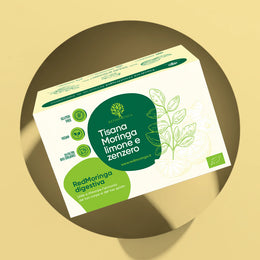
| Tea or infused leaves | Not defined: only part passes into the water | Softer taste, a pleasant ritual | Not a dose; often blended with other plants | Anyone who wants it as a drink, not as a supplement |
Fresh moringa is practically impossible to find in Europe and spoils within days. As for drying, the studies by Saini in 2014 and Ademiluyi in 2018 show that the method changes how much of the vitamins and polyphenols remain (freeze-drying preserves the most, oven-drying the least), but almost nobody writes it on the label: it is a question to ask the seller, not a criterion you can read. For practical use of the two forms there is the guide on how and when to take moringa capsules and the one on how to use moringa powder.
Marketing tricks to recognise
Four phrases appear on almost every moringa for sale, and none of them tells you whether the product is good. Recognising them saves you time and money.
"1,650 mg" or "2,000 mg" in large print on the pack
A big number says nothing until you know what it refers to: capsule weight, leaf, extract, and in how many capsules. A 1,650 mg dose in 3 capsules makes sense; in 6 capsules it is a different story. The honest comparison is always mg of leaf per dose, and price per gram of leaf.
"20:1 extract, twenty times more potent"
The ratio tells you how much leaf was used, not how "strong" the result is: that depends on the solvent and on what is retained. Without knowing what the extract contains, the ratio is just a marketing number.
"Seven times the vitamin C of oranges"
These comparisons have been circulating for decades, almost always without a source, and they often compare fresh or dried leaf with fruit gram for gram, while nobody eats 100 grams of moringa powder. And drying changes vitamin C in particular. They are not a criterion for choosing.
"100% pure moringa"
It may be true, and it is a good sign, but it needs checking: look at what comes after the moringa in the ingredients list. If you find only the capsule, it is pure; if you find bulking agents, flavourings or other plants, "pure" is a word, not a fact.

How to work out the real price of moringa
The fair price is calculated per gram of leaf: the price of the pack divided by the grams of leaf it contains, that is the number of capsules times the milligrams of leaf per capsule, divided by a thousand. It is the only way to compare a 60-capsule bottle with a 240-capsule one, or capsules with powder.
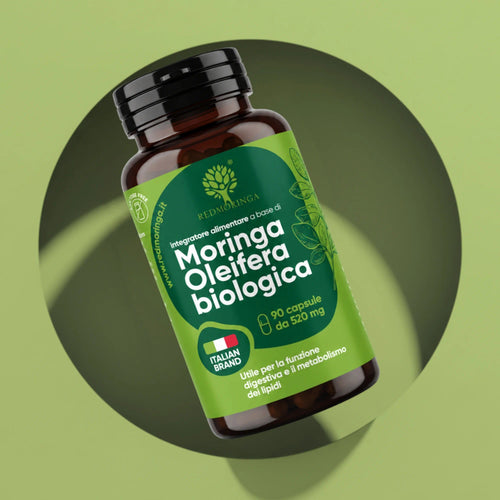
Let us do the maths with our own products, so you can also see where choosing us is not the better deal. A bottle of capsules costs €24.90 and contains 90 capsules of 420 mg, that is 37.8 g of leaf: €0.66 per gram, €0.83 a day for 1.26 g. With the 3- and 6-bottle packs the price drops to €0.52 and €0.46 per gram, or €0.66 and €0.58 a day. The powder costs €18.00 for 175 g: €0.10 per gram. At the recommended 8 g a day you spend about €0.82 a day, almost the same as the capsules, but you take more than six times as much leaf.
| Product | Price | Leaf in the pack | Price per gram of leaf | Cost per day |
|---|---|---|---|---|
| Capsules, 1 bottle | €24.90 | 37.8 g | €0.66 | €0.83 (1.26 g) |
| Capsules, 3 bottles | €59.13 | 113.4 g | €0.52 | €0.66 (1.26 g) |
| Capsules, 6 bottles | €105.12 | 226.8 g | €0.46 | €0.58 (1.26 g) |
| Powder, 175 g | €18.00 | 175 g | €0.10 | €0.82 (8 g) |
The same calculation works for any brand. If a product costs much less than the others for the same grams of leaf, ask yourself where it saved: certification, testing, excipients. If it costs much more, ask what it gives you extra that you can check. For where to buy it, channel by channel, there is the guide on where to buy moringa.
Our moringa, against the same 8 criteria
It would be easy to tell you ours is the best; we would rather put it in the same table and let you judge, telling you also when it is not the right choice.
| Criterion | RedMoringa Organic Moringa Oleifera capsules |
|---|---|
| 1. Part of the plant | Moringa oleifera Lam. leaves only |
| 2. Form | Leaf powder, no extract |
| 3. Leaf per dose | 1,260 mg in 3 capsules, 420 mg per capsule |
| 4. Organic | Certified organic, code IT-BIO-004; from certified organic farms, packed in Italy |
| 5. Testing | Microbiology and allergens on every batch; heavy metals and pesticides on the incoming raw material |
| 6. Capsule and excipients | Plant-based HPMC capsule, no bulking agents or flavourings; vegan, lactose-free |
| 7. Price per gram | From €0.66 to €0.46 depending on the pack |
| 8. Pack | Closed bottle, batch and expiry printed; 1 bottle = 1 month |
Moringa is useful for digestive function and for lipid metabolism: these are the two physiological effects recognised for moringa, and we do not promise you any others. Our capsules have 430 reviews on our website, 88% of them five stars; the powder has 63, with an average of 4.9.
When not to choose ours
- If you want the lowest price per gram of leaf: capsules are not it. Take the powder, ours or another organic producer's with testing.
- If you want an extract standardised for a specific substance: our capsules are whole leaf powder, not an extract.
- If you are looking for moringa seeds or oil: they are different products with different uses; we cover them in the guide on moringa seeds.
- If you are pregnant: we advise against moringa as a supplement, ours or anyone else's. If you are breastfeeding, take medication every day or have a thyroid condition, talk to your doctor first: for the thyroid we have a dedicated guide on moringa and the thyroid, and the other situations are on the page about moringa contraindications.
Frequently asked questions about which moringa to choose
What is the best brand of moringa?
There is no best brand overall: there is the product that declares leaves only, the mg of leaf per dose, an organic certification with a code and contaminant testing. Compare brands on these criteria and per gram of leaf, not by online rankings.
Are moringa capsules or powder better?
Capsules give a precise dose and no taste; powder gives much more leaf for the same daily cost and can be used in cooking. Choose by how you will use it every day: the form you actually take is the best one.
How can I tell if moringa is pure?
Read the ingredients list: after "Moringa oleifera, leaves" there should be only the capsule. If bulking agents, flavourings or other plants appear, it is not pure. For powder, the only ingredient should be the dried leaf.
How much does good moringa cost?
It depends on the form: our capsules cost from €0.46 to €0.66 per gram of leaf depending on the pack, our powder €0.10. For any brand, do the maths per gram of leaf and ask where a product much cheaper than average is saving.
Is organic moringa really better?
Organic guarantees a farming method checked by a third-party body, verifiable with the code on the label. It does not replace contaminant testing, which is a separate criterion: ideally you want both.
Who should not take moringa?
We advise against moringa as a supplement during pregnancy. If you are breastfeeding, take medication every day or have a thyroid condition, ask your doctor first and bring the label with you.
Sources
- Grosshagauer S. et al. The Future of Moringa Foods: A Food Chemistry Perspective. Front Nutr, 2021. PMID 34796194
- Shih M.C. et al. Effect of different parts (leaf, stem and stalk) and seasons (summer and winter) on the chemical compositions and antioxidant activity of Moringa oleifera. Int J Mol Sci, 2011. PMID 22016645
- Walia K. et al. Qualitative Microbiological Risk Assessment of Moringa oleifera Leaf Powder To Be Used To Treat Undernutrition in Infants and Children in Cambodia and India: A Review. J Food Prot, 2019. PMID 30810376
- Kumssa D.B. et al. Variation in the mineral element concentration of Moringa oleifera Lam. and M. stenopetala (Bak. f.) Cuf.: Role in human nutrition. PLoS One, 2017. PMID 28388674
- Saini R.K. et al. Effect of dehydration methods on retention of carotenoids, tocopherols, ascorbic acid and antioxidant activity in Moringa oleifera leaves and preparation of a RTE product. J Food Sci Technol, 2014. PMID 25190880
- Ademiluyi A.O. et al. Drying alters the phenolic constituents, antioxidant properties, α-amylase, and α-glucosidase inhibitory properties of Moringa (Moringa oleifera) leaf. Food Sci Nutr, 2018. PMID 30510713
- Commission Regulation (EU) 2023/915 on maximum levels for certain contaminants in food (lead, cadmium, mercury in food supplements).
In short
You do not need rankings to choose moringa: you need eight answers. Leaves only, powder or a declared extract, mg of leaf per dose, organic with a code, testing the seller can explain, no unnecessary excipients, price per gram of leaf, a closed pack with a batch number. If you want a moringa that answers all eight in writing, with a precise dose and no taste, discover RedMoringa Organic Moringa Oleifera capsules.