



The contraindications of moringa

The contraindications of moringa do exist, but they are far more specific than what you read online. Most sources mix up information on roots, leaves, bark and seeds without distinguishing between them — creating an alarmist picture that does not match the reality of clinical studies on moringa oleifera in supplement form. Many people avoid moringa for the wrong reasons, while those who really should be careful do not get the right guidance.
In this guide we look at the four categories of people for whom moringa calls for documented caution — thyroid, pregnancy, anticoagulant and blood-pressure-lowering medications, and use of the roots — and we debunk the most common myths. You will also find the safe doses and practical guidance for anyone who wants to take moringa without risk.
Real contraindications vs. exaggerated risks: how to tell them apart
Before listing the contraindications, it helps to understand why so much inaccurate information circulates in this field. Moringa oleifera is a plant whose parts are very different from a chemical point of view: the leaves — used in food supplements — have a well-documented safety profile; the roots and bark contain potentially toxic alkaloids that are not found in the leaves. Many "moringa contraindications" found online come from studies on the roots, often conducted on animals, wrongly applied to leaf/powder supplements.
The distinction is fundamental: when we talk about the contraindications of moringa supplements (leaves, leaf powder, capsules) we are talking about something very different from the root. The properties of moringa oleifera all come from the aerial part of the plant, not from the roots.
The documented contraindications of moringa oleifera
Thyroid: the goitrogenic mechanism you should know about
This is the most frequently cited and most misunderstood contraindication. Moringa contains glucosinolates, compounds that the body partially converts into thiocyanates. Thiocyanates interfere with the active transport of iodine in the thyroid gland, competing for the same transporter (NIS, sodium-iodide symporter) — a mechanism similar to that of broccoli, Brussels sprouts and other brassicas.
This makes moringa a mild goitrogen. The clinically relevant risk is concentrated in two specific conditions:
- Hypothyroidism treated with levothyroxine (Eutirox, Tirosint): moringa may reduce absorption of the drug if taken at the same time, and thiocyanates may interfere with the response to therapy. The practical solution is to space the intake of moringa at least 4 hours apart from the thyroid medication.
- Pre-existing iodine deficiency: in people with borderline iodine intake, a high and continuous consumption of goitrogens may make things worse. In Italy, where iodine deficiency is still widespread in some areas, this is a factor not to be ignored.
For those with a healthy thyroid and adequate iodine intake, standard doses of moringa (3–6 g/day of leaf powder) do not pose a documented risk. Learn more in the dedicated article on moringa and the thyroid: what the research says.
Pregnancy and breastfeeding
For pregnant women the recommendation is to absolutely avoid moringa roots: they contain moringine and spirochin, alkaloids to which uterotonic effects and — at high doses — abortifacient effects have been attributed. This indication is supported by animal studies and by the traditional ethnobotanical use of the root as an emmenagogue.
Moringa leaves during pregnancy fall into a different category: in many African and Asian cultures they are eaten as food during pregnancy for their iron, calcium and folic acid content. The WHO recognizes moringa as a nutritious food for pregnant women in developing countries. That said, supplement doses (higher than food use) have not been specifically studied in pregnancy with controlled clinical trials. The precautionary principle advises limiting yourself to food amounts and consulting your doctor. If you are looking for safe supplements in pregnancy, read the guidance on folic acid in pregnancy.
During breastfeeding moringa (leaves) is traditionally considered a galactagogue — that is, capable of stimulating milk production. Some systematic reviews confirm an increase in milk production in the first weeks postpartum with moringa supplementation. At this stage, food-supplement doses (up to 3 g/day) appear to be safe, but it is still recommended to inform your doctor.
Anticoagulant and antihypertensive medications
Research attributes possible effects on coagulation and blood pressure to moringa — which is why anyone taking medications with these effects should talk to their doctor.
With anticoagulants (warfarin, acenocoumarol/Sintrom, heparin, new oral anticoagulants such as rivaroxaban and apixaban): moringa contains a significant amount of vitamin K and also has antiplatelet effects. The interaction with oral anticoagulants works in both directions and cannot be predicted in advance — vitamin K reduces the effect of warfarin, while the antiplatelet effect strengthens it. Anyone taking anticoagulants should avoid sudden changes in moringa intake and inform their doctor.
With antihypertensive medications: preliminary studies have observed effects of moringa on blood pressure. Those already on antihypertensive therapy may experience hypotension if they add moringa without adjusting the dosage of the drug. See the article on moringa and blood pressure for details of the studies.
Moringa roots: this is the real absolute contraindication
The roots and bark of moringa contain spirochin, a neurotoxic alkaloid not present in the leaves. Cases of paralysis in rats and dose-dependent liver toxicity have been documented in animal studies with root extracts. For humans, acute toxicity data are limited but sufficient to advise against its use as a concentrated supplement.
A quality supplement uses only leaves or leaf powder, certified and with microbiological and heavy-metal analyses. Before buying, check that the label specifies "leaf powder" and not simply "moringa" with no indication of the part of the plant.

Moringa and the thyroid: beyond goitrogens
The moringa-thyroid interaction deserves a closer look because it is the topic on which most recent research is focused. Paradoxically, moringa has both potentially goitrogenic effects (due to glucosinolates) and thyroid-stimulating effects (due to its content of selenium, zinc and other micronutrients). The net result depends on the dose, the frequency of intake and the baseline state of the thyroid.
A 2020 study published in the Journal of Ethnopharmacology (Vergara-Jimenez et al.) analyzed the glucosinolate composition in moringa leaves and concluded that the concentrations are significantly lower than in brassicas with a high goitrogen content (kale, Brussels sprouts). This suggests that the goitrogenic risk of moringa leaves is comparable to or lower than that of a diet rich in cruciferous vegetables, which is generally not contraindicated in thyroid patients in the absence of iodine deficiency.
The practical recommendation for those with thyroid problems is: do not automatically rule out moringa, but agree on the supplementation with your endocrinologist, tell them the dosage and monitor TSH values after 4–6 weeks. Separating it from levothyroxine by time (at least 4 hours) is the most important precaution.
The most common myths about moringa contraindications
Besides the real contraindications, there are several false claims circulating online. Identifying them is just as important, because they push people who could benefit from moringa to rule it out for unfounded reasons. For a complete overview, also see the article on moringa myths.
"Moringa is bad for the liver" — The available studies, on animal models, do not indicate liver toxicity at food doses. Studies on rats treated with carbon tetrachloride (hepatotoxic) show that moringa reduces markers of liver damage (ALT, AST). The only documented liver risk concerns the roots at high doses, not the leaves.
"Moringa cannot be taken with diabetes" — False. Some studies have observed effects of moringa on blood sugar after meals: this is why caution is needed for those on therapy. The concrete risk is hypoglycemia if moringa is taken together with insulin or hypoglycemic drugs, not an absolute contraindication. Anyone on diabetes therapy should tell their doctor and monitor blood sugar in the first few days.
"Moringa is contraindicated in case of cancer" — There is no scientific evidence to support this claim. Moringa must never replace cancer treatments, but it is not contraindicated alongside them.
"Moringa is addictive" — There are no plausible biological mechanisms or evidence of dependence. This is a concern wrongly transferred from other adaptogenic herbs.
Safe doses and how to take moringa without risk
For those who do not fall into the at-risk categories, the safe doses of moringa leaf powder are well documented. The WHO has classified moringa as safe for food use with no established dose limit, but studies on pharmacological supplementation suggest practical ranges.
Standard adult dose: 3–6 g/day of leaf powder, corresponding to 6–12 capsules of 500 mg. This is the dose used in most of the available clinical studies.
Maximum tolerated dose: 12 g/day in short-term safety studies. Above this threshold there are no systematic human studies; animal data suggest an absence of acute toxicity even at much higher doses (for the leaves), but the absence of data is not the same as documented safety.
When to take it: moringa capsules are typically taken with meals. For more on how to use them specifically, see the guide on moringa oleifera capsules: how and when to take them.
Food interactions: moringa is a food and does not interact with other foods in a clinically significant way. The precaution concerns only the medications listed above.
If you are considering moringa supplementation and want to understand whether it suits your specific situation, first read the complete guide on moringa oleifera as a supplement: who it is suitable for.
Frequently asked questions about moringa contraindications
Is moringa contraindicated with thyroid medications?
It depends. With levothyroxine (Eutirox, Tirosint) moringa is not absolutely contraindicated, but it should be taken at least 4 hours apart to avoid interfering with the absorption of the drug. Your doctor must be informed of the supplementation. Those with untreated overt hypothyroidism or severe iodine deficiency should avoid high doses of moringa leaves until their thyroid values have stabilized.
Can a pregnant woman take moringa?
Moringa leaves in food amounts have been eaten for centuries in African and Asian cultures during pregnancy and are considered safe by the WHO. Concentrated supplement doses (over 3 g/day) have not been studied in pregnancy with clinical trials: caution advises limiting yourself to food use and consulting your gynecologist. Moringa roots, on the other hand, are absolutely contraindicated in pregnancy.
Does moringa interact with warfarin or other anticoagulants?
Yes, there is a potential two-way interaction: the vitamin K contained in moringa may reduce the effect of warfarin, while the antiplatelet effect of moringa may strengthen it. Anyone taking oral anticoagulants (warfarin, Sintrom, DOACs) should not start or change their moringa intake without informing their doctor. INR monitoring is recommended in the first weeks.
At what dose does moringa become dangerous?
For the leaves, there are no toxicity data in humans at reasonable doses. Safety studies indicate that up to 12 g/day of leaf powder for short periods is well tolerated in healthy adults. Very high and prolonged doses have not been studied. The roots, on the other hand, are toxic even at relatively low doses because of their spirochin content: no quality supplement includes them.
Is moringa contraindicated with diabetes?
No, but it requires monitoring. Some studies have observed effects of moringa on blood sugar after meals. The concrete risk is hypoglycemia if the effect of moringa is added to that of insulin or hypoglycemic drugs. Anyone on diabetes therapy should tell their diabetologist before starting supplementation and monitor blood sugar more often in the first 2–3 weeks.
Is moringa powder bad for the liver?
No: moringa leaves have hepatoprotective effects documented in preclinical studies. The liver risk concerns only roots and bark at high doses, not leaf powder. A certified supplement that uses only leaves presents no documented liver risks at standard doses.
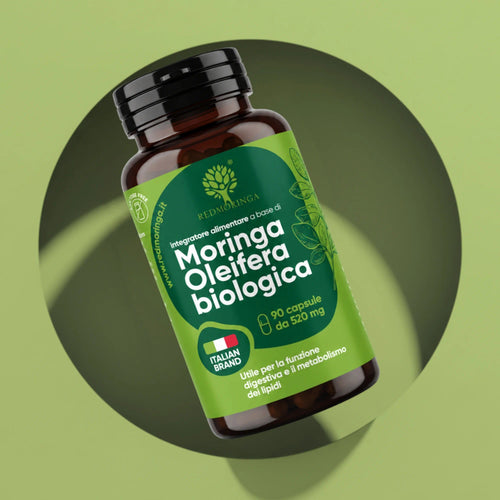
Organic Moringa Oleifera — certified leaves, no roots
Only organic leaves, with purity analyses on every batch: the choice for those who want moringa with maximum transparency.
Discover the product →Sources: RedMoringa Organic Moringa Oleifera label; Italian Ministry of Health guidelines on plant substances and preparations in food supplements (botanicals, Ministerial Decree of 10 August 2018, Annex 1).
Content for information purposes only; it does not replace medical advice. Food supplements should not be used as a substitute for a varied and balanced diet and a healthy lifestyle.